The Step Toward Professionalism:My Artistic Resume
My journey toward artistic independence has been shaped by continuous growth and the joy of sharing knowledge. On this page, I’ll take you through the most important milestones of my career: from my first exhibitions, through my enriching teaching experience, to my current representation by international galleries. Discover how a passion turned into a professional career.
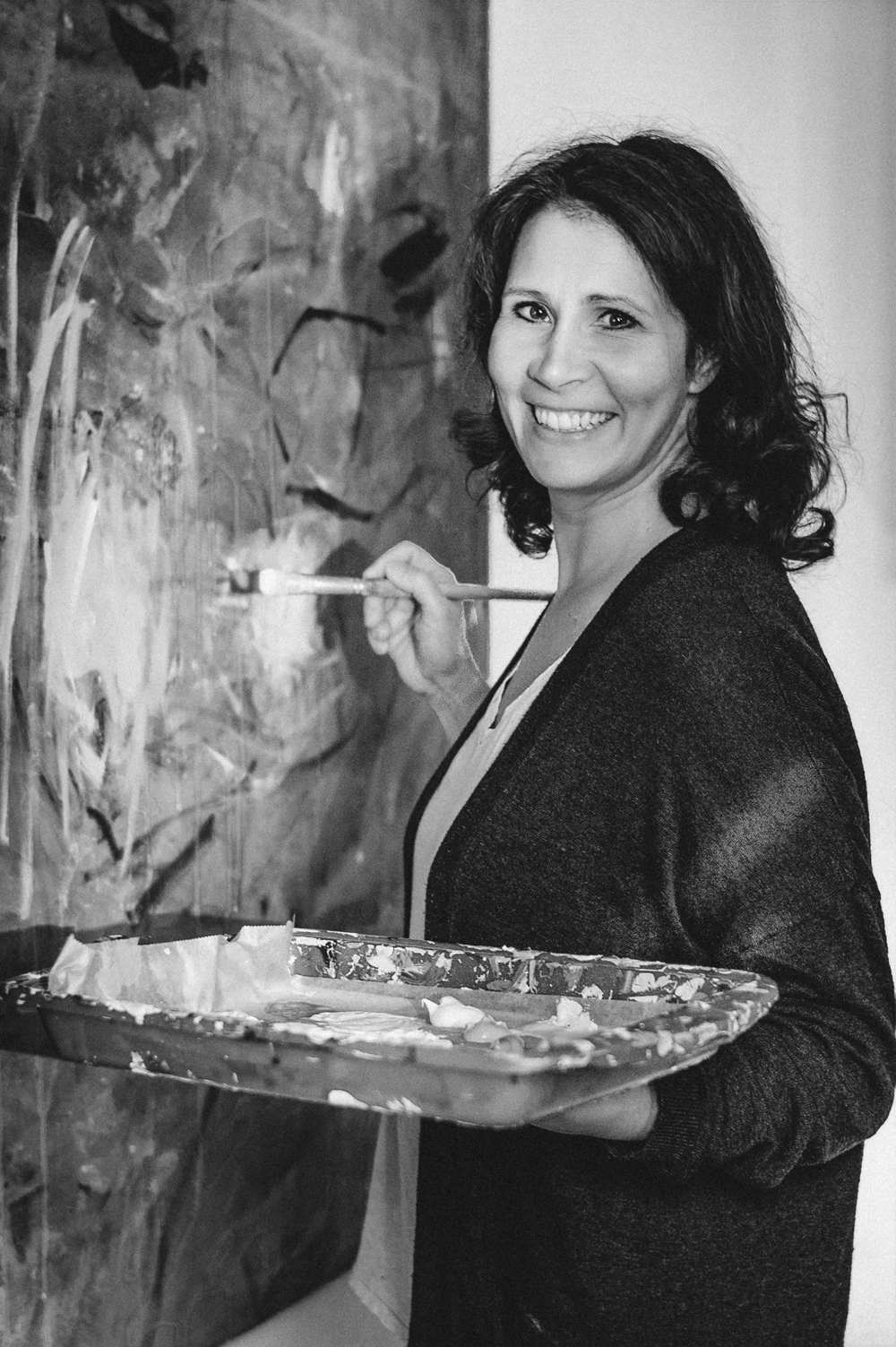
An Early Passion: From Watercolor Sets to Large-Format Acrylic Paintings
Painting is the one constant in my life. It all began when I was about 13 years old with a small watercolor set containing seven colors—back then, as a teenager, I sat among seniors in my first adult education classes. It didn’t bother anyone, least of all me. I remained faithful to watercolor and its lightness for years. The major turning point came in 2001 in Berlin: At the independent painting school run by artists Jürgen Sage and Astrid Albers, I was introduced to large-format acrylic painting on canvas. My love for watery, glazed paint application continues to shape my work to this day—it’s unmistakably evident in the hand-dyed papers I use for my modern collages.
The Leap into Freedom: My Journey as an Independent Artist
Born (1973) and raised in Ludwigshafen am Rhein, my path led me first into the business world after earning my master’s degree in German language and literature and history (in Mannheim and Waterloo, Canada). Until 2009, I worked as a product manager in the food industry in Berlin, the Allgäu, and the Chiemgau. Painting was my constant, faithful companion throughout all those years.
In 2009, I finally mustered all my courage and made my dream come true: taking the leap into self-employment as a freelance artist and photographer. After numerous successful group exhibitions, my first major solo exhibition followed in 2016, where I was able to present my entire artistic portfolio.
Find out more about my exhibitions
A Self-Taught Artist Driven by Inner Motivation: The Development of My Own Visual Language
My creative hub, my studio, is located in the industrial park in Gräfelfing in the beautiful Würm Valley near Munich. From the very beginning, my art has sprung from within me and followed my own unique inner drive. To experiment with new techniques and gain fresh inspiration at the start of my journey, I took targeted continuing education courses at renowned art academies—such as the Freie Kunstakademie Augsburg, the Akademie Kolbermoor, and the Kunstakademie Bad Reichenhall. Being self-taught and these occasional exchanges at the time complemented each other perfectly for me.
A very special milestone on this journey was my encounter with the Augsburg-based artist Andrea Rozorea, who provided me with significant support in my artistic development at that time. From this valuable exchange, a close friendship and a series of successful, jointly realized exhibition projects have grown to this day.
Would you like to know more about how I taught myself? If so, I recommend this article—it’s well worth reading:
“Interview with the art historian Dr. Ines Kehl ”
Artistic Evolution: Three Techniques in Creative Interplay
I love taking on new challenges time and again and consciously switching between different techniques. It is precisely this dynamic shift that drives the evolution of my art—because it constantly gives rise to something new as the techniques influence one another.
My portfolio currently encompasses three major areas of design:
- Abstract Acrylic Painting: Powerful, large-scale works painted directly on canvas.
- Mixed-media techniques using textural materials: A tactile approach (mixed media) on wood or canvas using pigments, ash, sand, coffee grounds, and ground stone.
- Abstract paper collages: Works created with great passion using delicate, hand-dyed Chinese papers.
Would you like to learn more about my approach? These three techniques are explained in more detail in a short video about me and my work.
Watch the video right here
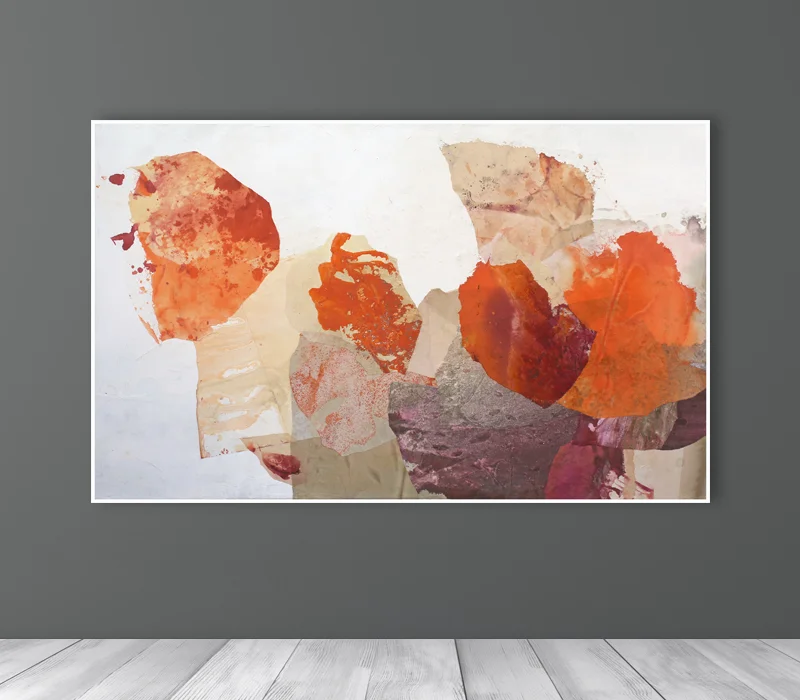
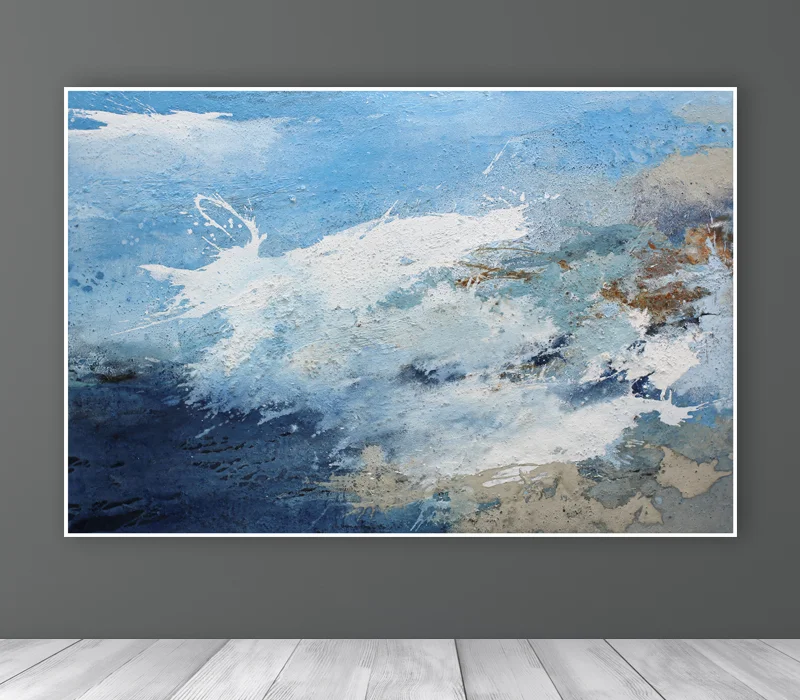
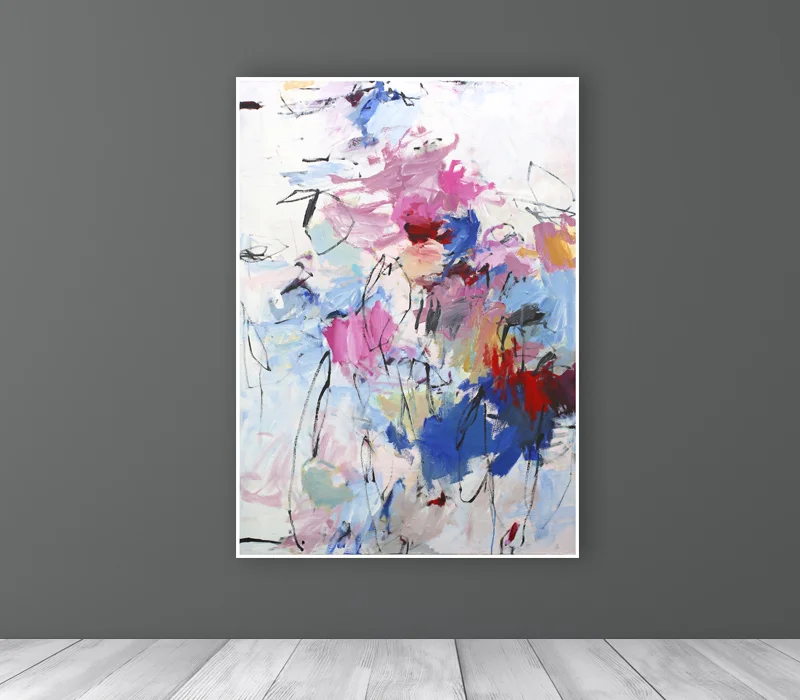
Video glimpse into the studio:
In my promotional video, I give you a concise look at my various working methods. In it, I explain what drives me every day and how I find artistic inspiration for my abstract works.
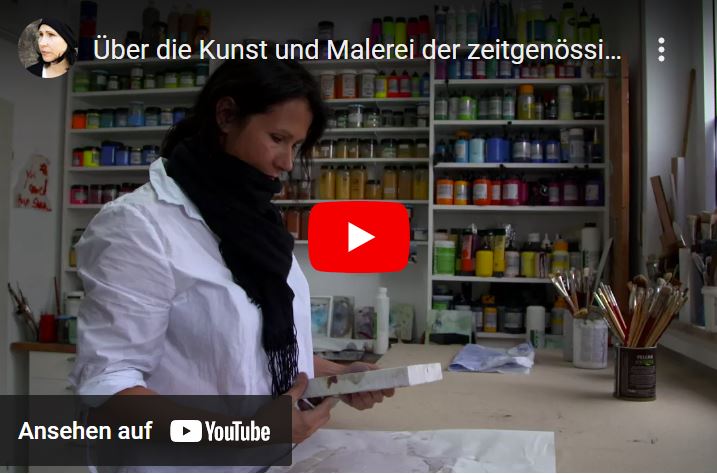
Experience art live:
Would you like to see the paintings and collages “in person” and at your leisure after viewing these digital previews? I cordially invite you to visit me at my studio at Lohenstraße 18 in Gräfelfing. Just give me a call at 0172-6513428 to schedule a private appointment at your convenience, or stop by on Saturdays during regular opening hours. I look forward to meeting you in person!
Please get in touch with me!
International Gallery Representation
Since 2022, I have been officially represented by the renowned Belgian FROCK Gallery in Ypres . In addition to major solo exhibitions in Belgium—such as those in the winter of 2022 and in September 2024—the gallery is bringing my abstract works to the international stage: It regularly showcases my paintings at major art fairs around the world in London and Brussels, including the renowned Affordable Art Fair. An exclusive selection of my works can also be purchased at any time directly through the gallery’s online shop.
Discover Katja Gramann at the FROCK Gallery
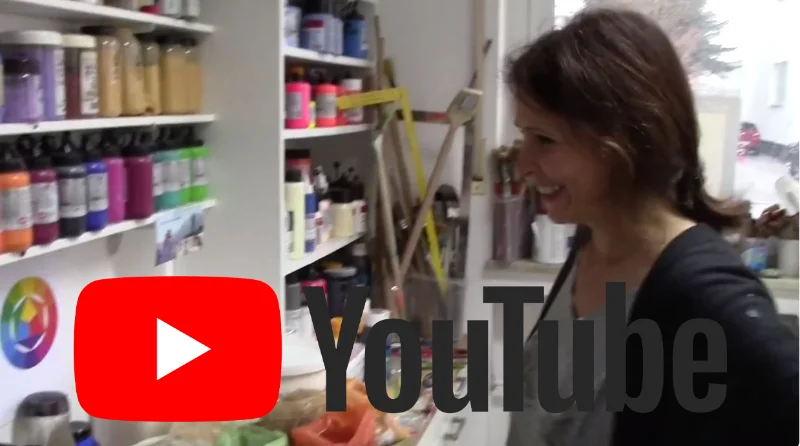
A special highlight of this collaboration was a visit by my gallery owner, Matt Frock, to my studio in Gräfelfing. This resulted in an exciting video series that shows me explaining my techniques and creating my large-format artworks right there in the studio.
Would you like to take a look behind the scenes and see how I work in my studio? Just click on the photo below to watch the video!
Represented on international art platforms
Buy my artwork online internationally
Starting now, you can also purchase my artwork through the world’s most renowned art platforms. Thanks to my collaboration with the Cuencas Art Gallery, selected works are now available to collectors worldwide on Artsy , the world’s largest art platform.
Alternatively, you can easily purchase my artwork online through the Singulart platform. Both channels offer secure, international shipping directly to your home.
Knowledge Transfer and Teaching: My Work as a Lecturer at Art Academies
Sharing my expertise in technique, materials, and image composition forms a second pillar of my artistic practice. Since 2021, I have been sharing my expertise as an instructor in abstract and informal painting at renowned institutions—including the Academy of Fine Arts (AdbK) in Kolbermoor and the Kunstfabrik Wien. I have continuously expanded my academic teaching portfolio: Since 2026, courses at the Eigenart Art Academy in Bad Heilbrunn have enriched my portfolio, followed by my teaching position at the Free Art Academy in Römerstein starting in 2027.
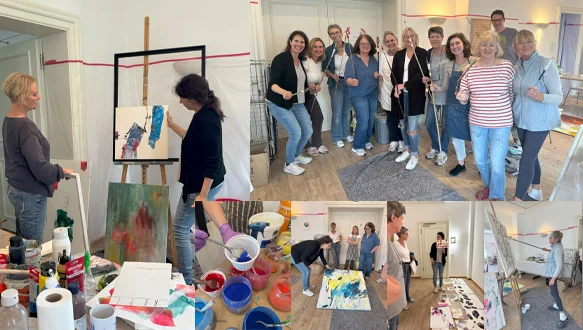
In addition to these regular academy programs, I regularly invite art enthusiasts to my own studio: Since 2021, I have been hosting “open studio classes” in Gräfelfing near Munich. The lively, inspiring atmosphere and the professional value of these collaborative creative processes are also reflected in the consistently positive feedback and Google reviews from former participants.
The complete and up-to-date course schedule, including all registration options, is presented in detail in the “Courses” section.
Discover the current course schedule
Publications and Catalogs: My Works in Print
Three catalogs offer a glimpse into my work.
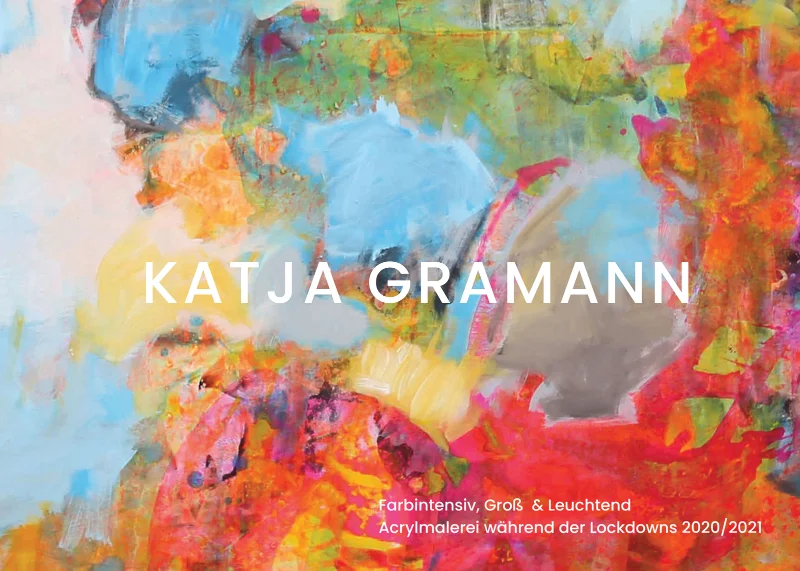
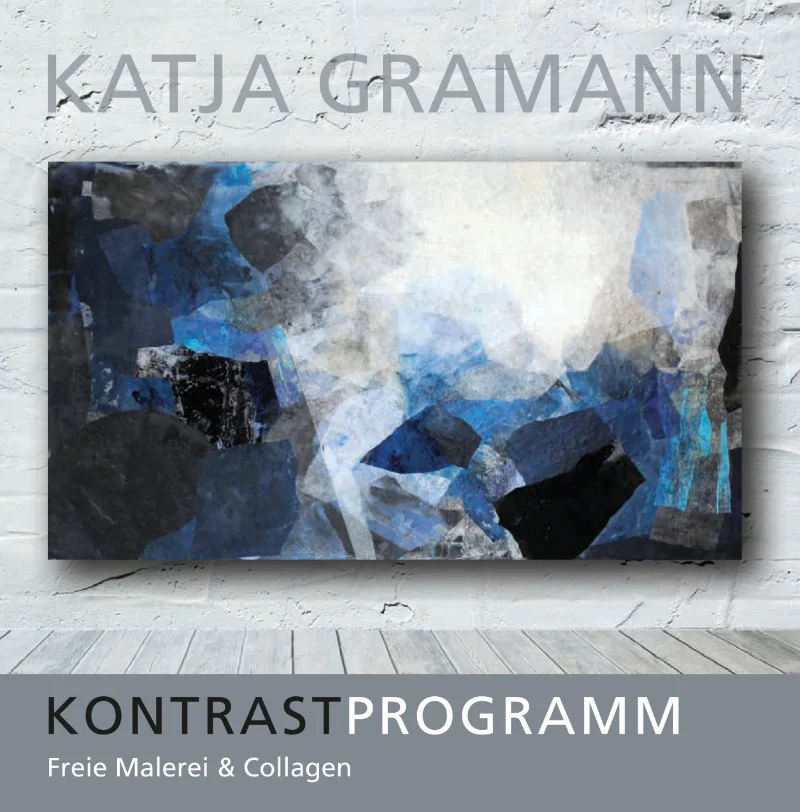
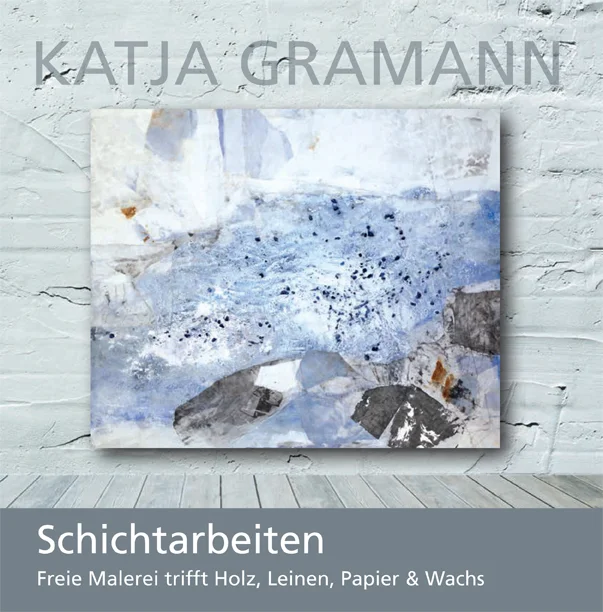
In 2021, I documented my acrylic works in the catalog “Acrylic Painting,” which features 17 selected paintings created during the lockdowns. Separate catalogs were also published for earlier exhibitions in 2016 and 2017: “Schichtarbeiten” and “Kontrastprogramm.” Unfortunately, both catalogs are now out of print.
The “Acrylmalerei” catalog can be purchased for €10.00 (plus €1.80 shipping) on account. Simply send me a short message via my contact form—I’ll ship your copy right away.
Art-Historical Context:Where My Painting Fits In
On my homepage, I deliberately describe my portfolio using the term “modern art.” In practice, it turns out that people who want to buy abstract artworks or find inspiration online usually search for “modern art.” The term has become firmly established in common parlance—despite the fact that, from an art-historical perspective, it often comes across as a vague buzzword. After all, what does it actually mean? Does it refer to abstract painting per se, or rather to art that harmonizes with a modern, design-oriented interior?
Modern Art or Contemporary Painting? An Attempt to Define the Terms
From an art-historical perspective, “modern art” does not exist in this form. There is only the era of “Classical Modernism,” which roughly encompasses the period between 1900 and 1938 and includes movements such as Expressionism, Dada, and Cubism. This was followed by Postmodernism, before the era of “Contemporary Art”—which continues to this day—developed. “Contemporary” basically just means “current.” However, since unwieldy terms like “contemporary abstract painting” are rarely used as search terms in everyday life, I pragmatically adapt to the linguistic habits of my prospective clients on my website—even though I am, of course, thoroughly familiar with the art-historical discourse. This conceptual ambiguity likely also stems from the English term “Modern Art” (as in the world-famous Museum of Modern Art in New York), which is often mistakenly translated one-to-one as “moderner Kunst” in German-speaking countries. Whether “modern art” actually exists, given that society uses the term on a daily basis, is almost a philosophical question.
If you’d like to delve deeper into the exact boundaries of the various art periods, I recommend taking a look at my Art Wiki by Dr. Gardill.
So where do I see myself fitting in?
The answer is actually quite simple: I see myself as a contemporary artist dedicated to non-representational painting. In this regard, I clearly see myself as part of the tradition of Color Field painting and the Informel artists.
Art historians and curators Dr. Barbara Rollmann-Borretty and Dr. Ingrid Gardill have provided an in-depth analysis of my work. I would like to take this opportunity to recommend their insightful articles for further reading:
Dr. Rollmann-Borretty: Observations on the Wax Collages
Dr. Ingrid Gardill: On Gramann’s Free-Style Painting
Dr. Ingrid Gardill: On the “Glanzstücke” Series
Dr. Ingrid Gardill: Bringing Acrylic Paintings to Life – On the new series of neon paintings
Dr. Ingrid Gardill Abstract mixed-media painting with ash, charcoal, and pigments

